Loading...
Searching...
No Matches
RMGParticleFilterScheme Class Reference
Filter-output scheme for particles. More...
#include <RMGParticleFilterScheme.hh>
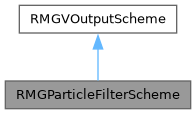
Inheritance diagram for RMGParticleFilterScheme:
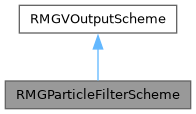
Collaboration diagram for RMGParticleFilterScheme:
Public Member Functions | |
| std::optional< G4ClassificationOfNewTrack > | StackingActionClassify (const G4Track *, int) override |
Wraps G4UserStackingAction::StackingActionClassify. | |
| void | AddParticle (int pdg) |
| Add a particle, identified by its PDG code, to the list of particles to kill. | |
| void | AddKeepVolume (std::string name) |
| Add a physical volume, by name, to the volumes in which the filter will not be applied. | |
| void | AddKillVolume (std::string name) |
| Add a physical volume, by name, to the volumes in which the filter will be applied. | |
| void | AddKeepProcess (std::string name) |
| Add a physics process by name. This will only keep the specified particles when they were created by this process, all other particles will not be kept. | |
| void | AddKillProcess (std::string name) |
| Add a physics process by name. This will apply the filter only to particles created by this process. | |
| Public Member Functions inherited from RMGVOutputScheme | |
| virtual void | AssignOutputNames (G4AnalysisManager *) |
| Initialize ntuple column names for this output scheme. | |
| virtual void | ClearBeforeEvent () |
| Clear any event-specific data. | |
| virtual bool | ShouldDiscardEvent (const G4Event *) |
| Decide whether to discard the current event. | |
| virtual bool | StoreAlways () const |
| Indicates whether the output scheme always stores event data. | |
| virtual void | StoreEvent (const G4Event *) |
| Store the event data. | |
| virtual std::optional< bool > | StackingActionNewStage (const int) |
| Hook for transitioning to a new stacking stage. | |
| virtual void | TrackingActionPre (const G4Track *) |
| Hook called before tracking a new particle. | |
| virtual void | TrackingActionPost (const G4Track *) |
| Hook called after tracking a new particle. | |
| virtual void | SteppingAction (const G4Step *) |
| Hook called after each step. | |
| virtual void | EndOfRunAction (const G4Run *) |
| Perform final actions at the end of a run. | |
| void | SetNtuplePerDetector (bool ntuple_per_det) |
| Specify whether to create separate ntuples for each detector. | |
| void | SetNtupleUseVolumeName (bool use_vol_name) |
| Specify whether to use the physical volume name for naming ntuples. | |
| void | SetEventIDOffset (int offset) |
Additional Inherited Members | |
| Static Public Attributes inherited from RMGVOutputScheme | |
| static std::string | fUIDKeyFormatString = "det{:03}" |
| Protected Member Functions inherited from RMGVOutputScheme | |
| virtual std::string | GetNtupleName (RMGDetectorMetadata det) const |
| virtual std::string | GetNtupleNameFlat () const |
| void | CreateNtupleFOrDColumn (G4AnalysisManager *ana_man, int nt, std::string name, bool use_float) |
| void | FillNtupleFOrDColumn (G4AnalysisManager *ana_man, int nt, int col, double val, bool use_float) |
| int | GetEventIDForStorage (const G4Event *evt) const |
| Protected Attributes inherited from RMGVOutputScheme | |
| bool | fNtuplePerDetector = true |
| bool | fNtupleUseVolumeName = false |
| int | fEventIDOffset = 0 |
Detailed Description
Filter-output scheme for particles.
This optional output scheme filters out all particles specified via their PDG code. Optionally, it can apply this filter to a specified volume or ignore a specified volume. Properties need to be specified per macro.
Does nothing if the output scheme is not enabled per macro before run initialization. Also does nothing if no particle is specified. If no volume is specified the filter is applied to all volumes.
Member Function Documentation
◆ AddKeepProcess()
| void RMGParticleFilterScheme::AddKeepProcess | ( | std::string | name | ) |
Add a physics process by name. This will only keep the specified particles when they were created by this process, all other particles will not be kept.
This means that specified particles that are not created by these processes will not be affected by the filter. It is therefore not possible to specify keep-processes and kill-processes at the same time.
◆ AddKeepVolume()
| void RMGParticleFilterScheme::AddKeepVolume | ( | std::string | name | ) |
Add a physical volume, by name, to the volumes in which the filter will not be applied.
This means that specified particles outside of the specified keep-volumes will be filtered. It is therefore not possible to specify keep-volumes and kill-volumes in the same geometry.
◆ AddKillProcess()
| void RMGParticleFilterScheme::AddKillProcess | ( | std::string | name | ) |
Add a physics process by name. This will apply the filter only to particles created by this process.
This means that specified particles that are not created by these processes will be filtered. It is therefore not possible to specify keep-processes and kill-processes at the same time.
◆ AddKillVolume()
| void RMGParticleFilterScheme::AddKillVolume | ( | std::string | name | ) |
Add a physical volume, by name, to the volumes in which the filter will be applied.
This means that specified particles outside of the specified kill-volumes will not be affected by the filter. It is therefore not possible to specify keep-volumes and kill-volumes in the same geometry.
◆ StackingActionClassify()
|
overridevirtual |
Wraps G4UserStackingAction::StackingActionClassify.
This is used to classify all specified particles as fKill if they are in the specified volumes (or no volume is specified).
If the primary particle is filtered out here, the simulation crashes. To avoid the crash, the particle will be simulated anyways and a warning message will be shown.
Reimplemented from RMGVOutputScheme.
The documentation for this class was generated from the following files:
- /home/docs/checkouts/readthedocs.org/user_builds/remage/checkouts/latest/include/RMGParticleFilterScheme.hh
- /home/docs/checkouts/readthedocs.org/user_builds/remage/checkouts/latest/src/RMGParticleFilterScheme.cc